

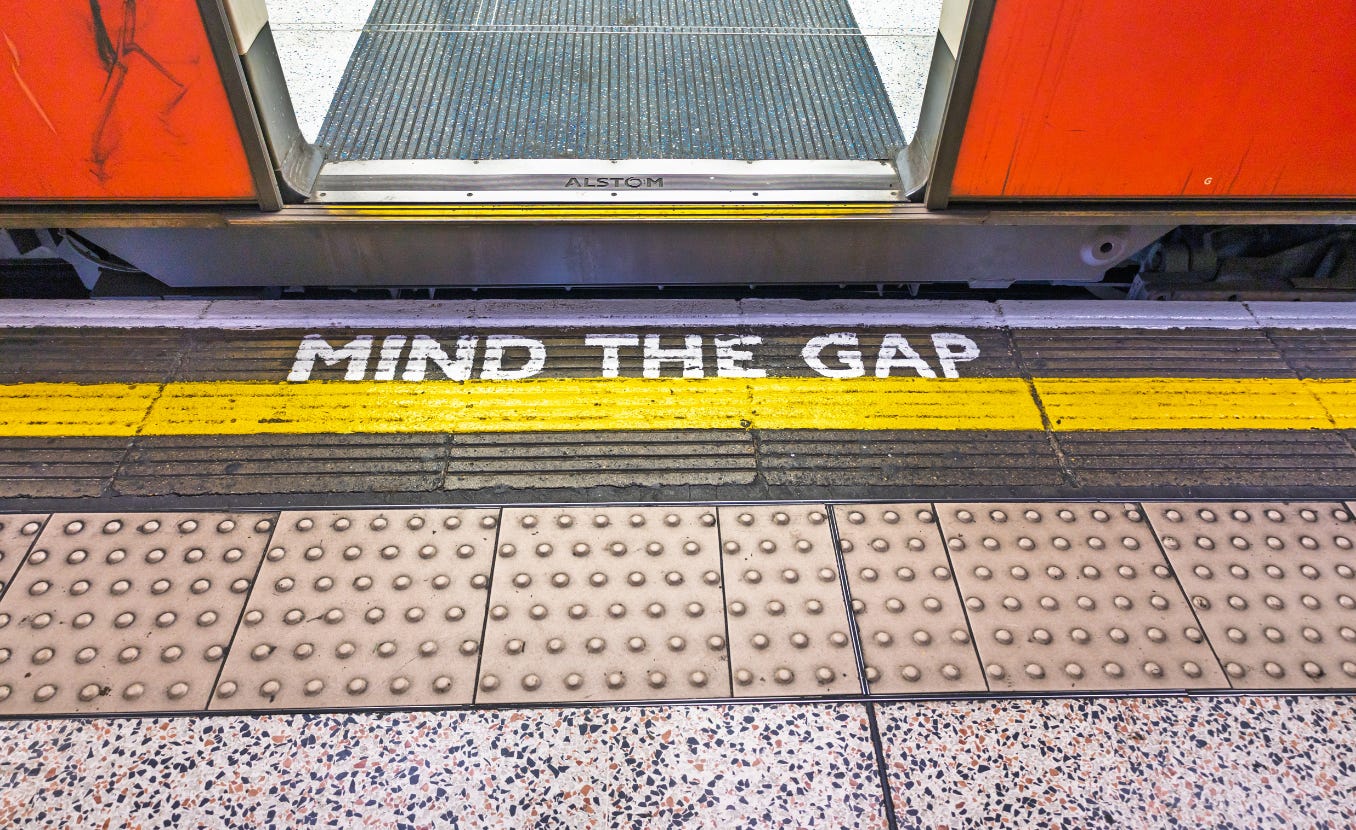
“Mind the gap” is a popular warning for rail passengers when moving between platforms, but it should also be a warning sign in your relationships. When trust has eroded in personal or business relationships, partners can find themselves worlds—and words—apart. The gap can feel insurmountable, as though you’re stretching and stepping beyond your comfort zone to maintain the relationship.
Think of this as your final warning before taking the step yourself.
But is there an early warning sign to help you see trust gaps in a relationship?
A Compatibility and Trust assessment seeks to help partners identify cultural fit (and trust gaps) across five dimensions:
Focus is the ability to combine individual roles into a corporate direction to benefit all stakeholders. There is a common purpose and direction and clarity around that direction.
Communication is the efficient and effective transfer of meaning through words and actions to achieve and grow mutually beneficial outcomes. It includes open and timely sharing of relevant information to a partner’s decision-making ability.
Team Orientation is the ability to focus and direct individual goals and objectives into a cohesive group strategy. Team orientation is a key indicator of how well trading partners work together.
Innovation is an organization’s ability to dynamically deal with change and its tolerance for risk and trying out new ideas and solutions. Strong and trusting relationships allow the parties to share risks and rewards, invest in each other’s capabilities and embrace continuous improvement and transformation efforts.
Trust is the consistency of performing to promise and meeting commitments. Without performance, trust cannot exist. Think of the CaT assessment as a DNA footprint of two organizations with the goal to identify how much overlap there is between the partner’s inherent DNA across each of the five dimensions. The assessment offers a chance to gauge cultural fit and choose “best friends” in a clear and empowering way.
There is a massive difference between “good” and “typical” relationships with partners. One early warning sign of trust gaps is the words we use to describe our partner.
Think of your cherished and respected partners, and words like “Collaborative” and “Trustworthy” might come to mind. A more demanding partner, one whose emails or calls make your blood pressure rise, might bring up words like “Frustrating” and “Difficult.”
Take a study of buyer-supplier relationships in the energy industry. Buying companies were asked to pick a “good” relationship and a “typical” relationship. Good relationships used mostly positive adjectives (85%) such as Aligned, Collaborative and Trustworthy to describe their relationship. But when team members were describing “typical” relationships, they used positive words much less frequently, only 63% of the time. Instead, they used words like Frustrating, Restrictive and Distant. And, in 9% of cases, people in these typical relationships used really negative words such as Difficult, Strained and even Dysfunctional.
It’s far too easy for partners to find themselves misaligned and the trust gap to widen.
One reason for the misalignment is the illusory superiority bias. The phenomenon is also commonly referred to as the “above-average effect” because typically well over fifty percent of respondents in surveys rate themselves above average in the perception of their own behaviors. For example, one study showed 93% of Americans rate themselves as above average for driving skills. Of course, that is statistically impossible.
Trust isn’t an endless chocolate fondue tower that will cover all of our relationships in sweet goodness. Rather it is something that takes time and attention to purposefully foster.
So before you take a step, be sure to mind the trust gap.